I recently taught a photo walk for Adorama. We started at the store on 18th Street. I had an assistant with me and a small portable strobe in a softbox. That was the entire kit.
We walked toward Union Square. In an hour, I stopped nine times — nine moments where something caught my eye, and I worked it. Not nine images. Each stop was its own scenario, its own setup, its own conversation with the people on the walk about what I was seeing and why. The point of a photo walk is not the count. The point is seeing.
(For what it’s worth, a real engagement session is a different animal. An hour with a couple gives you hundreds of frames, because once we’re working, there is no teaching pause, no stepping back to explain, no five photographers moving around me. The walk is slower because it is school. A session is faster because a session is the work.)
The walk was for teaching how seeing actually happens. Not as a theory but as a thing you watch a person do in real time on a sidewalk in Manhattan with a couple in front of her and an hour on the clock.
Here is what we did.
Stop one. The fire escapes.
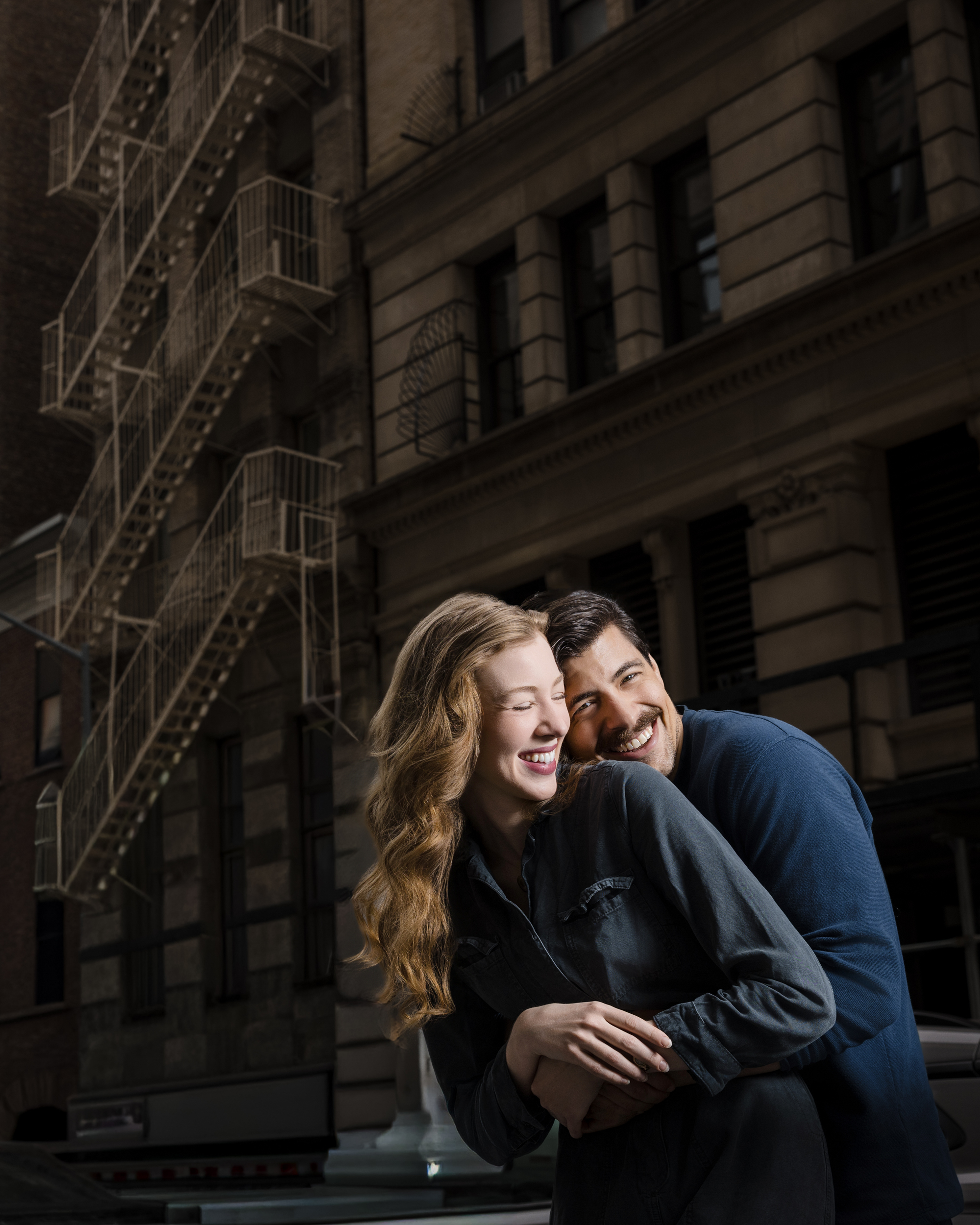
Half a block from Adorama, I crouched down. The two of them were standing on the sidewalk in front of an unremarkable building. From eye level, it was nothing. But if you got low — if you put yourself at the level of the curb and shot up — you could see the whole vertical history of New York behind them. Fire escapes. Old window frames. The cast iron lines of a building from the 1880s that nobody on the street looks at because nobody on the street looks up (unless you’re a tourist in Times Square, but that’s another story).
This was also the first stop where I used the strobe. The light on Manhattan sidewalks at midday is flat and overhead, doing almost nothing for skin. I had my assistant put the softbox down low and angle it to create warm side light, faking the kind of late-afternoon side light that would normally be hours away. The couple lit up. The building behind them stayed in its own ambient shadow. The whole frame is split into warm and cool tones, and the eye knows where to look.
The lesson was said out loud to the group: stop shooting at eye level all the time. Eye level is what every person on the sidewalk sees every day. That’s the photograph nobody needs you to make. Get low. Get high. Find the angle that shows people the city they live in, but do not actually look at.
Stop two. The window.
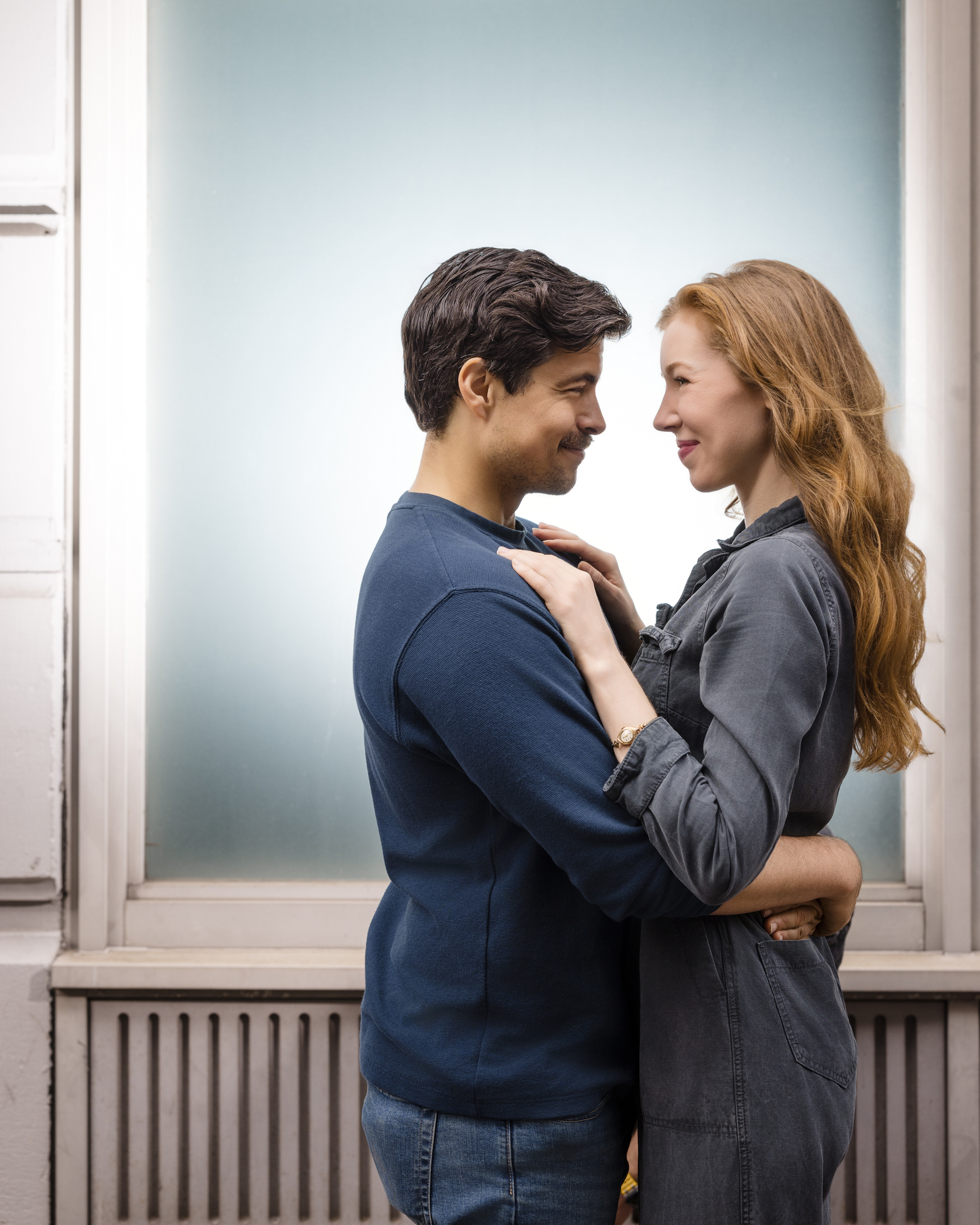
A storefront with a frosted window between two white frames. I positioned the couple in profile, centered within the window’s frame, and let the window serve as the light source. The diffused glow from inside did the work. No strobe this time.
The lesson: the camera frame is one frame. Find a second one inside it. Doors, windows, the gap between two buildings, archways, scaffolding, a slice of sky between two roofs. The city gives you frames constantly, and most photographers walk past them looking for a wider scene. The image gets immediately stronger because the eye has somewhere to land.
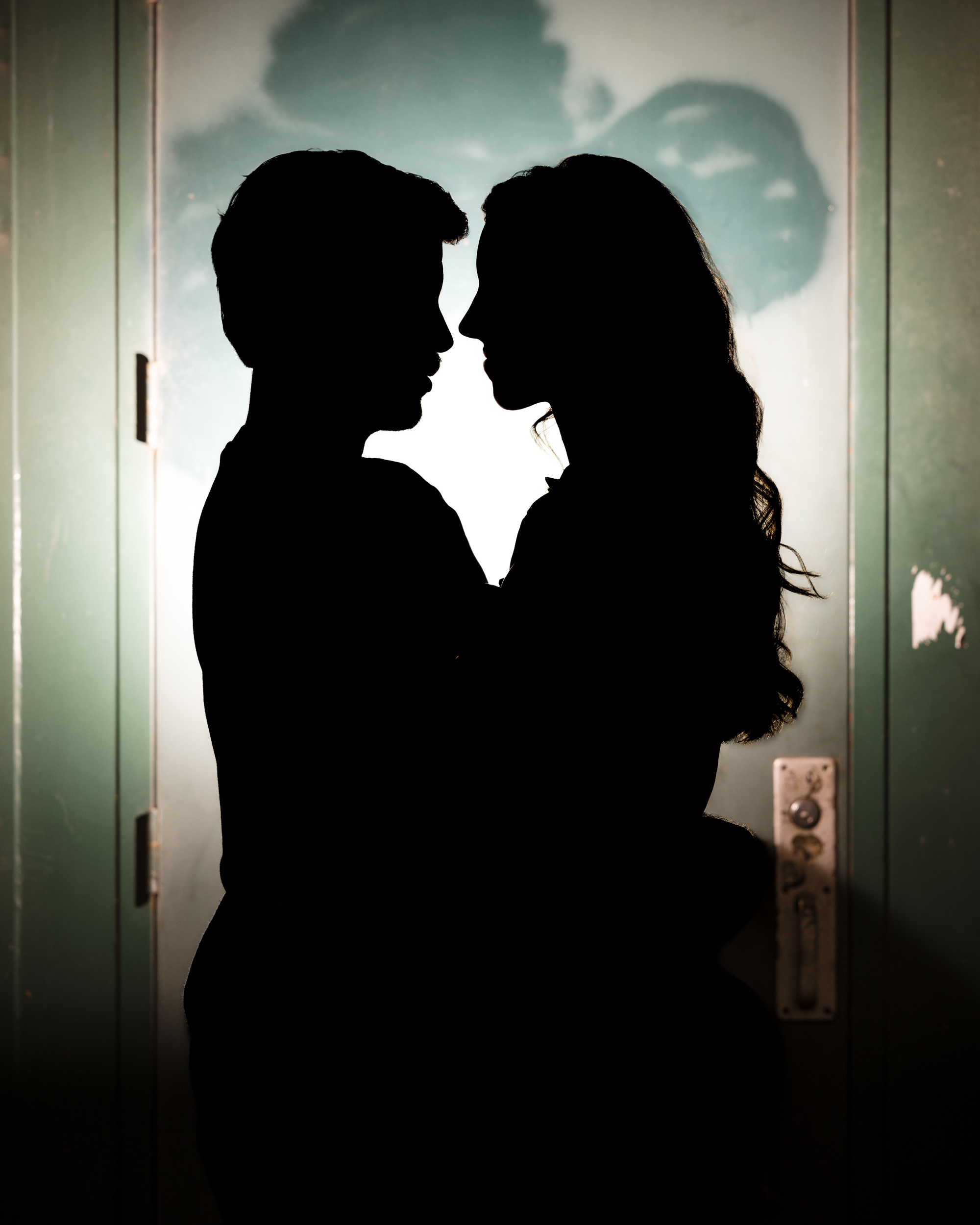
Stop three. The silhouette.
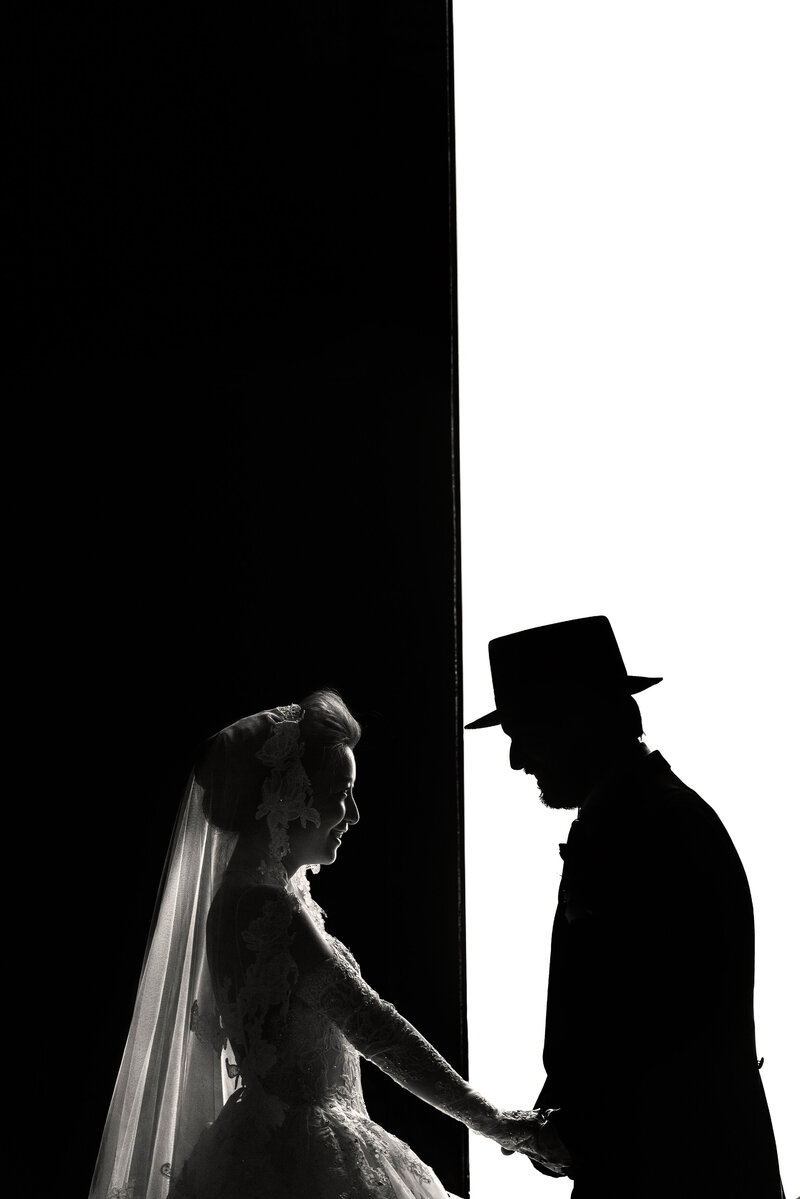
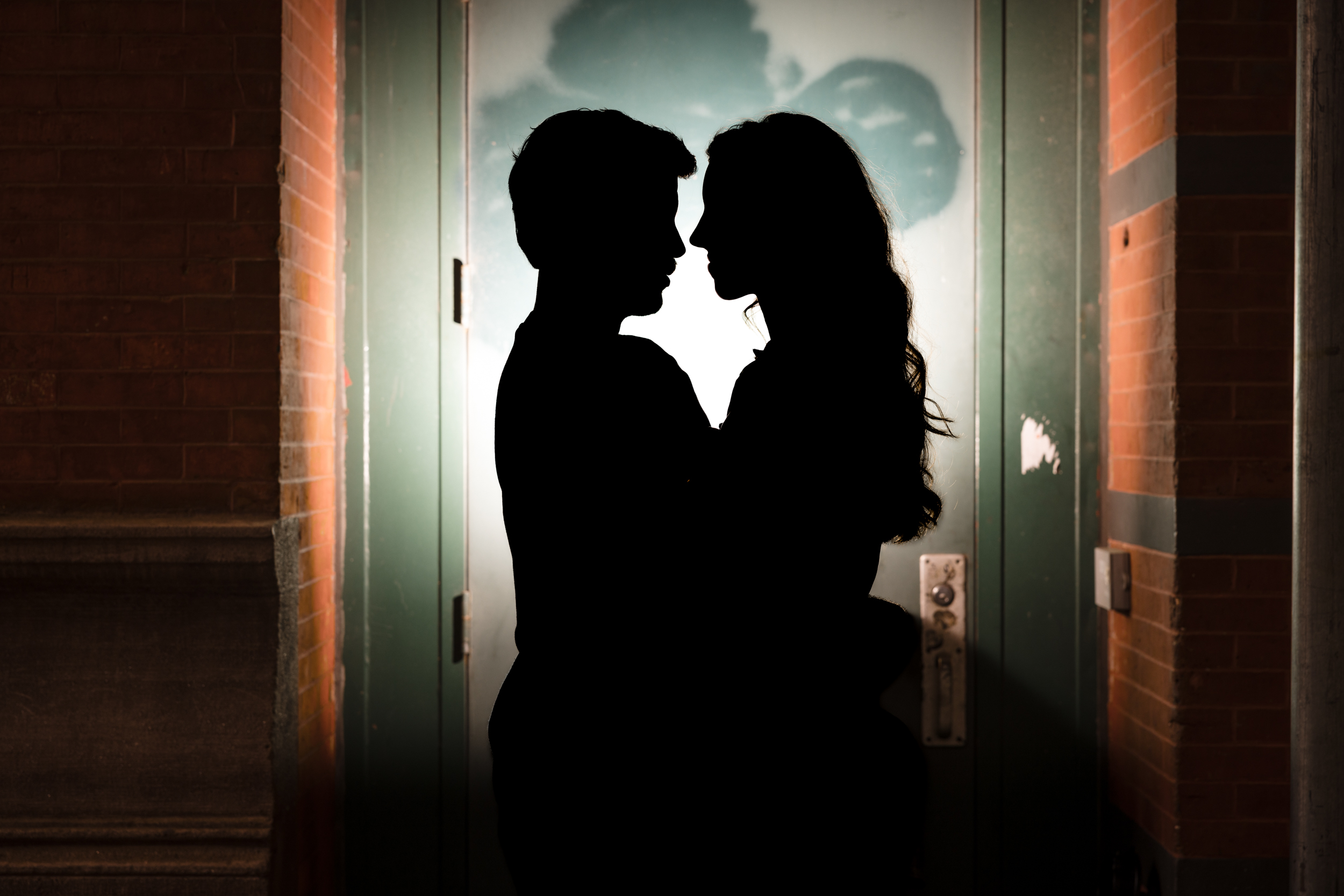
Around the corner from the window stop, an industrial green metal door with the painted ghosts of old signage faded into it. I had my assistant move the strobe behind the couple this time, between them and the door, and blow out the area where their faces nearly touched. The door went teal-green and patinated. They went pure black, silhouette to silhouette, a sliver of light between them.
This is a different lighting move from the one I made at the fire escape. At the fire escape, I lit the subjects and let the building fall into shadow. Here I did the opposite. I let the subjects fall into shadow and lit the space between them.
The lesson: a strobe is not a tool for making things brighter. It is a tool you use to put light where you want it. Sometimes that means lighting the people. Sometimes that means lighting around them. Knowing which move to make in any given frame is most of the job.
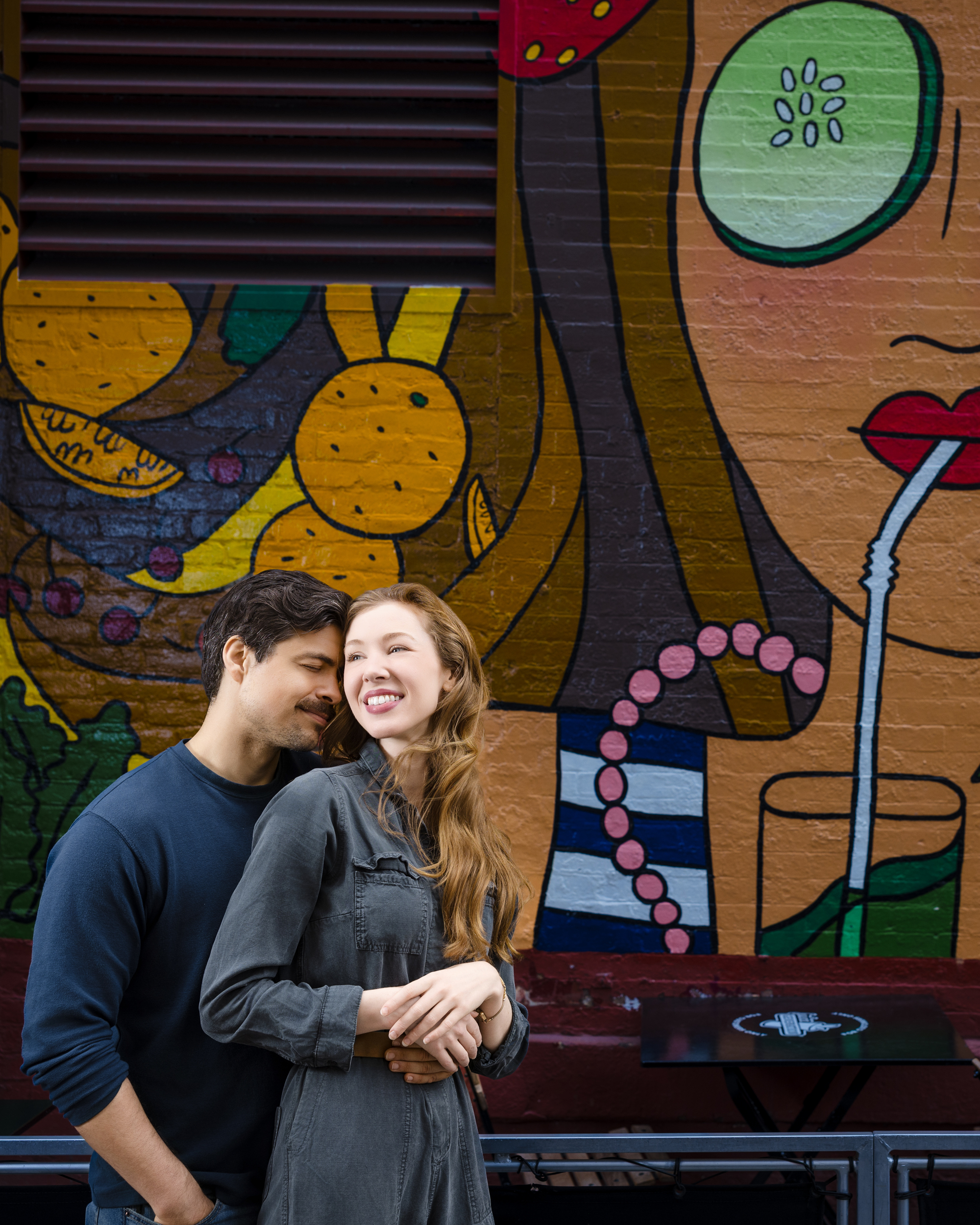
Stop four. The mural.
A few blocks later, a bright primary-color food mural on a brick wall — oranges, lemons, a giant cocktail glass with a strawberry on the rim. I positioned them in front of it. He tucked his head against hers. She laughed.
No strobe. The mural was doing all the work.
The lesson: when the background is loud, you stop being a lighting designer and start being a casting director. The wall is already dressed. Your job is to put two real people in front of it and trust that the contrast between the bright, graphic flatness behind them and the soft, three-dimensional human in front of it is the whole photograph. Don’t add. Subtract.
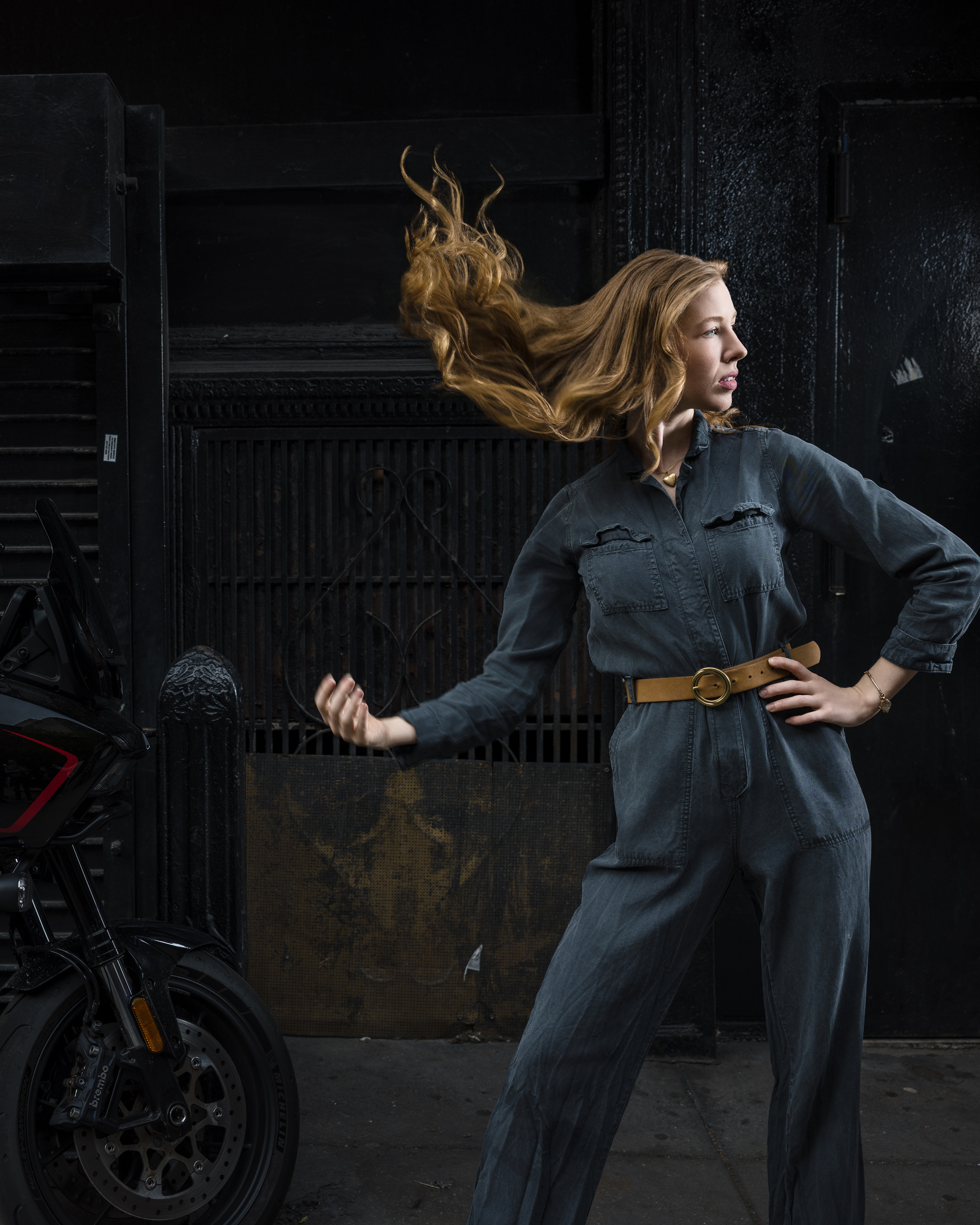
Stop five. The hair.
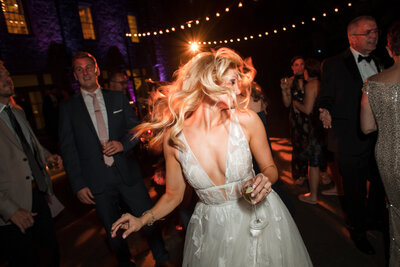
Outside a gated black industrial facade with a motorcycle parked beside it, I asked one of them to walk back across the frame and toss her hair as she turned. We did it three times. The third time, the hair went completely airborne, and the timing locked. Hand on her hip, weight shifted, hair caught at full extension.
This is the stop on the walk where I think the participants understood what I meant about looking for fun. Up to this point, we had been making thoughtful, considered photographs. Slow ones. This one is alive. It moves. It is one person against a background that, frankly, should not work — a black gate and a parked motorcycle should not be a portrait location (and FYI, it was a closed mattress store) — and the subject’s energy makes it work anyway.
The lesson: do not always shoot the couple. Sometimes, one person alone in their own moment is the photograph. And do not be precious about backgrounds. A gate, a bike, and a black-painted wall are fine if the person in front of it is fully alive. The image follows the energy. Find the energy first.
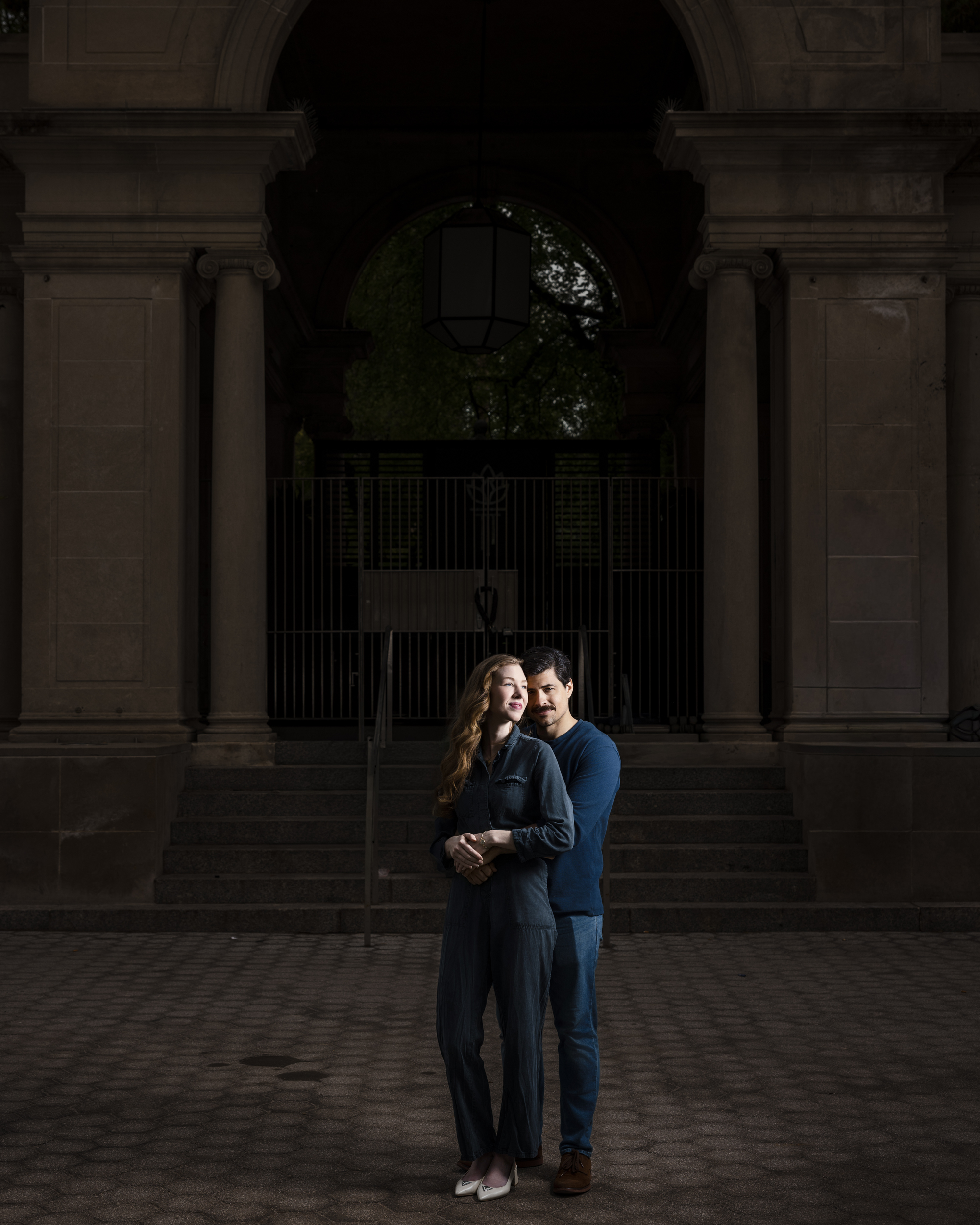
Stop six. The arch at Union Square.
We made it to Union Square. I looked at the trees. The trees were boring.
The arches were not. There is a stone pavilion at the north end of the park with tall Ionic columns and a coffered arched ceiling that almost nobody photographs because everybody is too busy photographing the trees. I positioned the couple at the base of the arches and stepped way back. They came out small in the frame. The architecture came out huge. The strobe lit them just enough to separate them from the dark stone.
The lesson, and probably the most important one of the six lessons so far: most photographers default to the obvious version of a location. In Union Square, that means the trees. In Central Park, that means the Bow Bridge. At the Brooklyn Bridge, that means the arches and the wooden walkway. There is nothing wrong with the obvious version. There is also nothing distinctive about it. If you want to make a photograph of a place that does not look like every other photograph of that place, you have to look past the obvious thing and find the second thing. Sometimes the second thing is better.
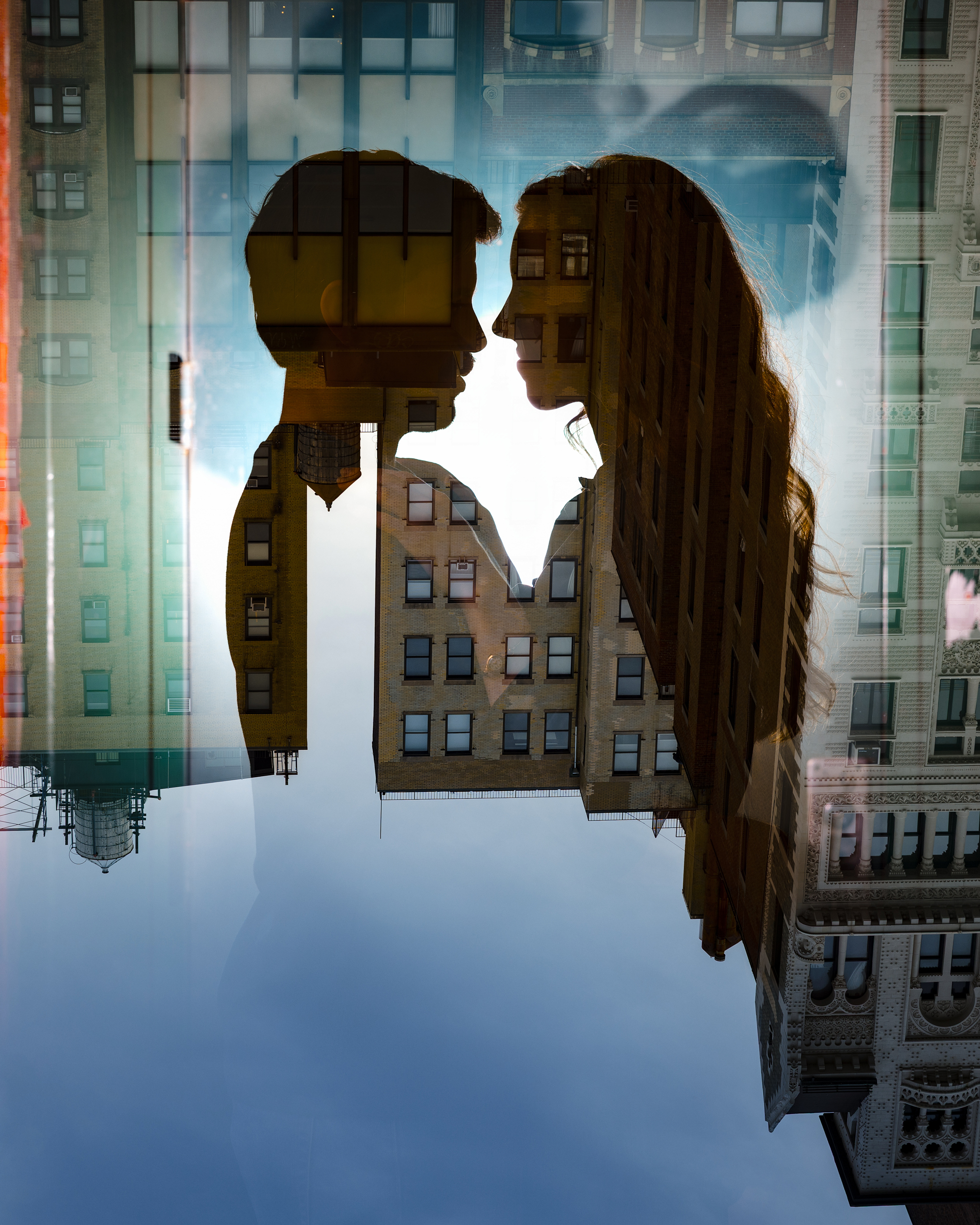
Stop seven. The double exposure.
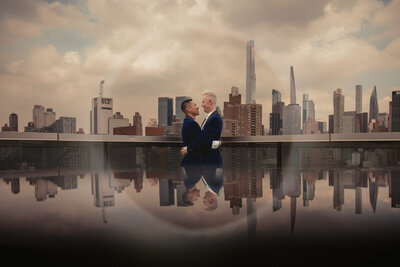
I made this one in camera. Two frames combined: the couple in silhouette as one exposure, the upside-down skyline as the other. Buildings inverted, water tower, sky, the architectural texture of lower Manhattan layered through their bodies.
This is the part that is hardest to teach because it is closest to instinct. There is a technique for a double exposure. Exposure compensation. Frame placement. Knowing what you are layering. But the technique is the easy part. The hard part is seeing it before you make it. Looking at two people in a square in Manhattan and seeing the city already inside them.
I told the group that this is how I see. I do not know how to teach the seeing itself. I can only show you what I made and tell you it came from looking at the same view they were in and noticing something different.
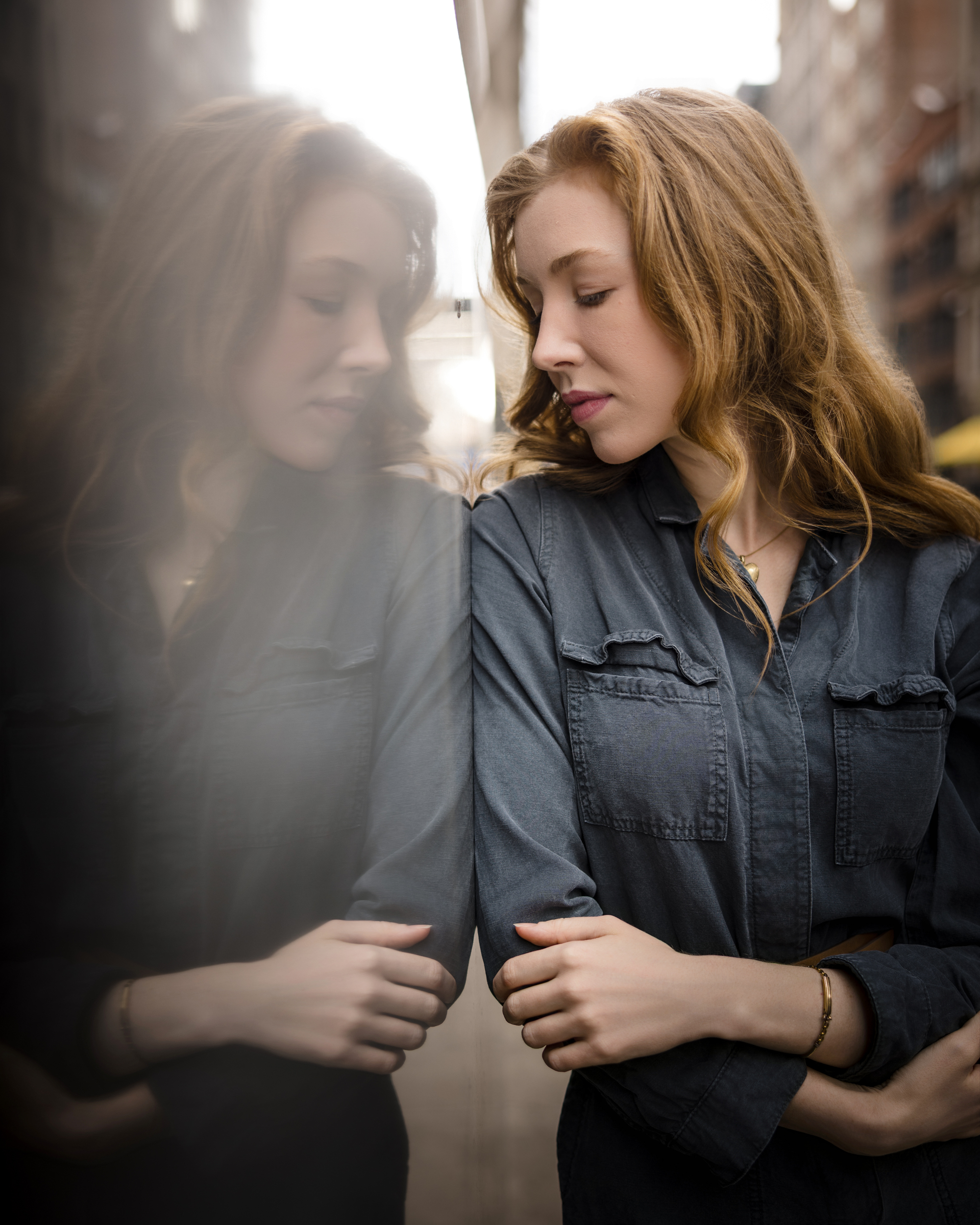
Stop eight. The reflection.
A bank facade somewhere on the way back, polished granite, the kind of surface most people do not register as reflective at all. I had her stand sideways, with her hands almost touching the granite, and took the photograph so that her real self and her reflected self were in conversation. Her hands meet her own hands. Her face in profile, her reflection in profile, both of them looking down.
The lesson: train yourself to see surfaces, not just subjects. Glass, water, metal, polished stone, car hoods, puddles, storefront windows. A reflection gives you two images for the price of one — the actual subject and the version of the subject the surface is showing you. Sometimes the reflection is the better image. Sometimes the reflection is the only interesting thing in the frame. Once you start looking, you cannot stop. Reflective surfaces are everywhere.
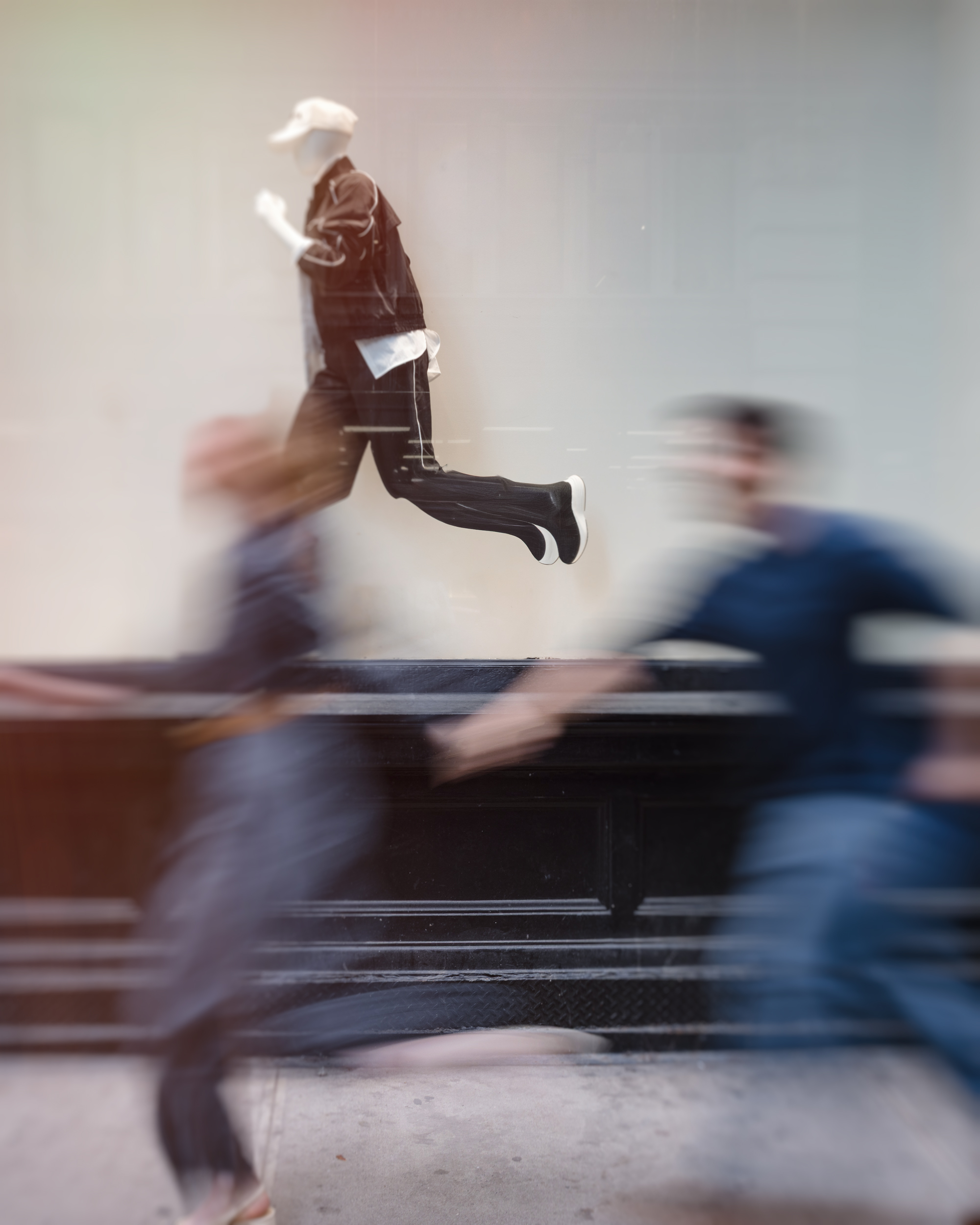
Stop nine. The mannequin.
Almost back to Adorama, a window display with a mannequin frozen mid-run. White cap, denim, sneakers in stride.
I had the couple run past it. I dropped the shutter way down. The mannequin in the window came out sharp because the mannequin was not moving. The couple came out as pure motion blur on either side of him — a streak of color and limb and laughter on the left and the right and the still figure between them.
The composition is the joke. The mannequin is the only thing standing still. The real people are the wind.
The lesson, which is maybe the most important lesson on the entire walk: look for fun. Photography is allowed to be fun. Engagement sessions are especially allowed to be fun. The whole industry has spent the last several years training photographers to make couples stand still, look serious, and gaze meaningfully at each other in soft light. That is one kind of photograph. It is not the only kind. The photograph of two people running past a running mannequin is going to outlast every editorial-restraint portrait I make this year. The couple will tell that story for the rest of their lives.
You cannot pre-plan the mannequin. The mannequin is a gift the walk gives you. Your job is to pay enough attention to see it.
A note on the strobe.
People on the walk kept asking me: when do you use it? The honest answer is, less than you think. The strobe and softbox in my assistant’s hands were there for one specific job. To fake the setting sun.
What I mean by that: golden hour is real for about thirty minutes. The rest of the day, the light in New York is what it is. Sometimes that light is beautiful. Sometimes it is flat midday garbage that does nothing for the skin or the romance. When the light is not there, I make it.
A small strobe through a softbox, placed low and warm, angled at the couple from the right direction, gives you the same falloff, warmth, and edge that the actual sun gives you when it is six minutes from the horizon. You can do it on a sidewalk at noon. You can do it in a stairwell. You can do it in a basement bar with no windows. It is not a trick. It is just knowing what good light looks like and being willing to put it where you need it instead of waiting for the sky to deliver.
This is the part that separates working photographers from photographers who are at the mercy of conditions. Conditions are almost never ideal. The wedding starts at eleven, and the ceremony is in a dark church, and the reception is in a tent with overhead halogen, and the portraits have to happen in fifteen minutes between the toasts. You cannot wait for golden hour. You bring golden hour with you.
The strobe is the smallest, simplest tool I own. I have been using some version of it for fifteen years. It costs less than a lens. It changes what is possible.
The thing I want to say at the end of this, to anyone who reads it, is that the walk was not really about the strobe, the double exposure, or the techniques.
The walk was about the practice of looking.
If you are a photographer, the most important thing you can train is your eye, and the way to do that is to walk around with a camera and pay attention to what pulls you. Not what you think is supposed to be photogenic. Not what other photographers are shooting on Instagram. What actually pulls you. The fire escape that catches the light a certain way. The reflection in the granite. The mannequin running.
You learn to trust those pulls. Learn to stop when they happen. You learn that the photograph almost always wants to be made, and you are usually the one who is in the way.
If you are not a photographer — if you are someone considering hiring a photographer for your wedding — what I want you to take from this is that the photograph is not made by the camera. It is made by the person walking around with the camera, deciding what to stop for. Nine teaching stops in an hour, on a walk where I was deliberately slowing down. Imagine what happens when I am not slowing down. Imagine what happens when the only thing I am paying attention to is you.
That is what you are hiring when you hire a photographer. Not the gear. Not the editing. The eye, and the willingness to use it.
Nine stops. One hour. One strobe.
A whole way of working, in sixty minutes on a Manhattan sidewalk.